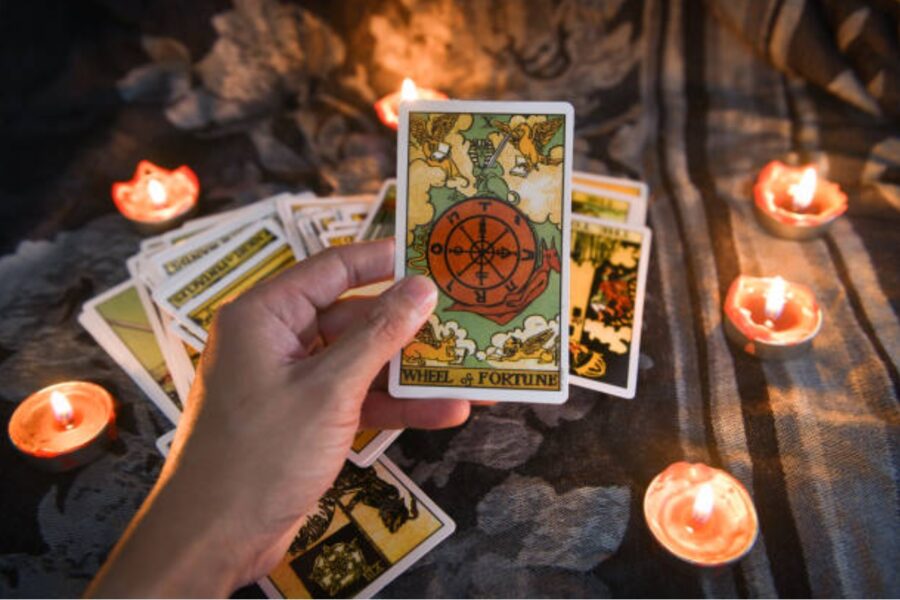
You Don’t Need to Memorise 78 Cards to Start
One of the biggest myths about tarot is that you have to spend months memorising card meanings before you can read. You don’t. Tarot is a conversation between you, the cards, and your intuition — and that conversation can start today.
Here’s your complete 7-step process for a first reading that actually means something.
Step 1: Choose Your First Deck
The best beginner deck is one you’re visually drawn to. That said, the Rider-Waite-Smith (or any of its derivatives) is the most beginner-friendly because every card features illustrated scenes that tell a story — making intuitive reading much easier than decks with abstract symbols.
Look for a deck where the Minor Arcana cards have full illustrations (not just rows of cups or swords). This is your biggest practical aid when starting out.
Step 2: Cleanse and Connect with Your Deck
Before your first reading, clear any residual energy from the deck’s manufacturing and previous handling. Simple methods:
- Knock on the deck three times with your knuckles
- Pass it through smoke from sage, palo santo, or mugwort
- Leave it under moonlight overnight
- Hold it to your heart and breathe your energy into it intentionally
Then spend a few minutes simply flipping through the cards, looking at each image without pressure to interpret.
Step 3: Set Your Intention
Tarot reads best when you ask a specific, open-ended question — not a yes/no question. Instead of “Will I get the job?” ask “What do I need to know about this job opportunity?” or “What energy should I bring to my career right now?”
Hold your question in mind as you handle the deck. Speak it aloud if you feel comfortable doing so.
Step 4: Shuffle Until It Feels Right
There’s no wrong way to shuffle. Common methods:
- Overhand shuffle — transfer cards from one hand to the other in sections
- Riffle shuffle — the classic playing card shuffle (fine for sturdier decks)
- Spreading and gathering — spread the cards face-down on a surface, swirl them, then gather them back together
Stop shuffling when you feel ready, or when a card jumps out — jumper cards are worth paying attention to.
Step 5: Use a 3-Card Spread
For your first reading, use the simplest and most powerful spread: three cards in a line.
- Card 1 (left) — The past: what has led to this situation
- Card 2 (centre) — The present: what is happening now / the core energy
- Card 3 (right) — The future: what is emerging / the likely outcome
Lay the cards face-down, then turn them over one at a time, pausing to observe each before moving to the next.
Step 6: Interpret Without the Guidebook (First)
Before reaching for the guidebook, sit with each card and ask yourself:
- What is the first thing I notice?
- What is the mood or feeling of this image?
- What does this make me think of in relation to my question?
Your gut response is often the most accurate reading you can give. Then — and only then — check the guidebook to deepen your understanding.
Step 7: Record Your Reading
Write down the cards you pulled, their positions, your initial impressions, and any emotions that came up. Date the entry. Come back to it in two to four weeks and see what landed true.
A tarot journal is one of the most powerful learning tools available — it shows you your own patterns and builds your relationship with the deck faster than any book can.
Common Beginner Mistakes to Avoid
- Reshuffling until you get a card you prefer — trust what comes
- Reading when emotionally flooded — ground yourself first
- Pulling too many cards before understanding simpler spreads
- Ignoring the imagery in favour of memorised definitions
Tarot is a practice, not a performance. Start simple, stay curious, and let the relationship with your deck develop over time.